



Race Car Scale Solution: Precision Corner Weight Measurement for Motorsport Setup
Professional Wired and Wireless Racing Scales for Accurate Wheel Weight, Axle Weight, Cross Weight and Vehicle Balance Detection
In professional motorsport, vehicle performance is not only determined by engine power, aerodynamics or tire grip. Accurate weight distribution plays a critical role in chassis balance, cornering stability, braking consistency and overall handling performance. The race car scale, also known as a corner weight scale, four-wheel weighing system or racing balance scale, is a precision measurement tool designed to help racing teams, tuning workshops and vehicle testing organizations accurately measure the independent weight of each wheel.
Guangzhou Xingjiufeng Electronics Co., Ltd. provides professional wired and wireless race car scale solutions for F1 and formula cars, GT cars, touring cars, rally cars, drift cars, karting, modified vehicles and motorsport testing applications. The system is designed to measure individual wheel weight, front and rear axle weight, left and right side weight, total vehicle weight, cross weight and weight distribution percentage in real time.
Built with high-strength aluminum alloy and premium steel materials, the racing scale combines lightweight portability, high precision, stable performance and strong durability. It helps engineers and mechanics quickly understand vehicle balance conditions, optimize chassis setup, adjust suspension parameters and improve racing performance.
Solution Overview
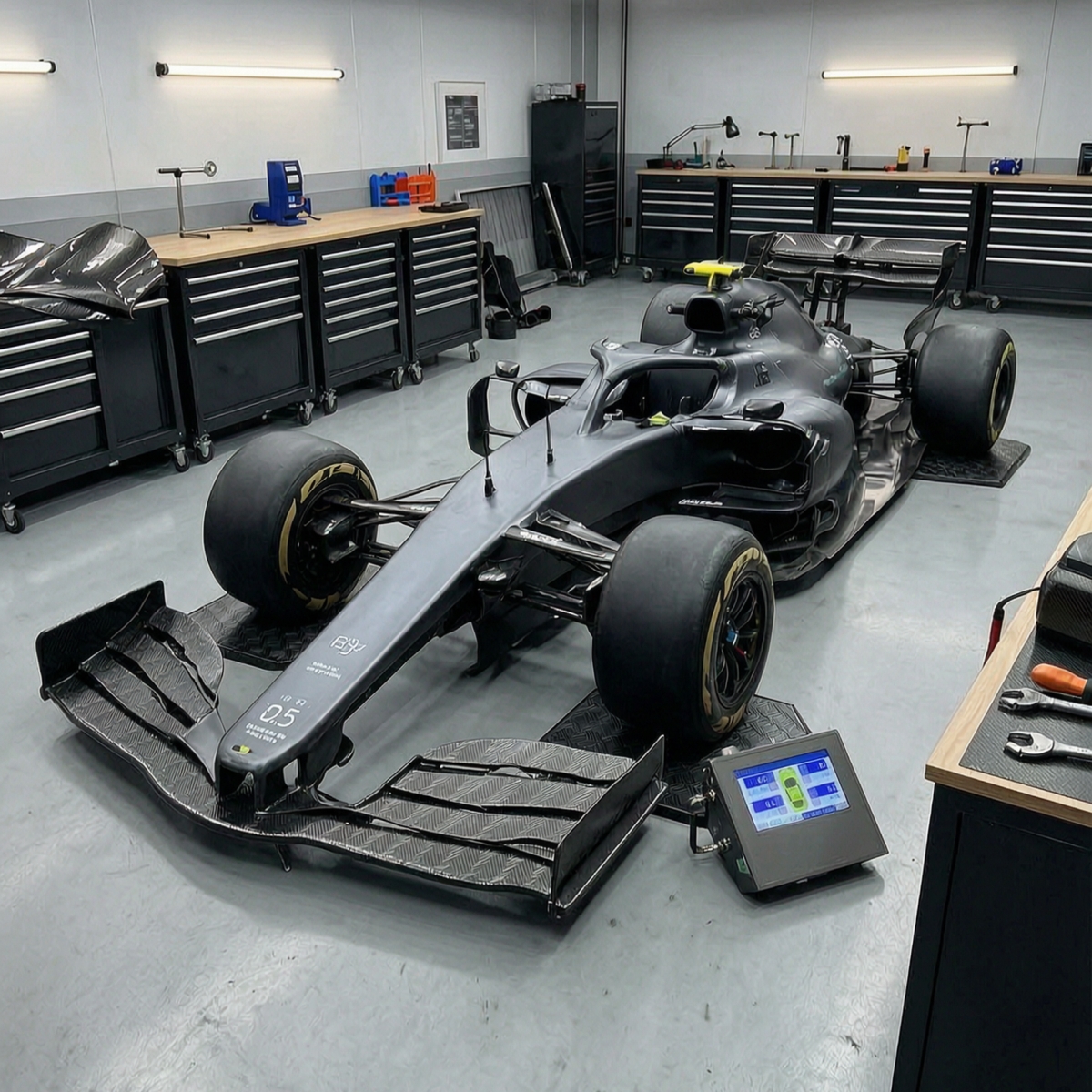
A race car scale solution is an essential setup tool for motorsport teams and performance vehicle workshops. By placing four precision weighing pads under the four wheels of a vehicle, the system collects real-time load data from each corner and calculates key setup values such as total weight, axle weight, left/right balance, front/rear distribution and cross weight.
Corner weight data is widely used in racing setup because it allows teams to understand how vehicle mass is distributed across the chassis. Professional racing scale systems commonly display individual corner weights, front/rear percentages, side-to-side percentages and cross-weight values, which are important references for chassis tuning, suspension adjustment and ballast placement.
The Xingjiufeng racing scale solution is available in both wired and wireless versions. The wired version provides stable data transmission for workshop and laboratory environments, while the wireless version reduces cable layout, improves operating efficiency and is more convenient for pit garages, race tracks and mobile testing scenarios.
Why Corner Weight Measurement Matters in Motorsport
1. Improve Cornering Stability
Uneven wheel load distribution may cause inconsistent handling when entering, passing through or exiting corners. By using a racing scale to measure each wheel load, engineers can adjust suspension preload, ride height or ballast position to achieve a more balanced chassis setup.
2. Optimize Tire Grip
Tire grip is strongly related to the vertical load applied to each tire. If one wheel carries significantly more or less load than expected, the vehicle may show poor traction, unstable braking or unpredictable cornering behavior. Corner weight measurement helps teams tune the vehicle for more consistent tire contact and better grip utilization.
3. Calculate Cross Weight
Cross weight, also called diagonal weight or wedge, refers to the combined weight percentage of one diagonal pair of wheels compared with total vehicle weight. It is one of the most important values in racing setup because it affects how a car behaves when turning left and right.
4. Support Ballast Placement
In many racing categories, teams need to meet minimum vehicle weight requirements. A racing scale helps determine where ballast should be added to meet the rules while minimizing negative effects on handling balance.
5. Detect Vehicle Problems
Abnormal corner weight data can help identify possible suspension deformation, uneven tire pressure, chassis misalignment, shifted components, bent control arms or side-to-side weight bias. This makes the system useful not only for racing setup but also for vehicle inspection and maintenance.
6. Meet Motorsport Compliance Requirements
Motorsport organizers, race teams and scrutineering departments may need to verify vehicle weight, ballast distribution or setup consistency. A precise racing scale system supports reliable vehicle weight checking before, during and after competition.
Customer Challenges
1. Inaccurate Chassis Setup
Without accurate corner weight data, chassis tuning often depends on driver feeling or repeated track testing. This may lead to inconsistent results, longer setup time and difficulty identifying the real cause of handling issues.
2. Uneven Left and Right Weight Distribution
A vehicle may appear visually balanced but still have hidden left/right or diagonal weight imbalance. Such imbalance can reduce braking stability, affect steering response and cause different handling characteristics in left and right turns.
3. Complicated Trackside Measurement
Race teams often need fast setup changes in garages or paddocks. Heavy, bulky or cable-heavy weighing equipment may slow down the measurement process and reduce operating efficiency.
4. Different Vehicle Types Require Different Scale Designs
Formula cars, GT cars, touring cars, karting vehicles, rally cars, drift cars and modified street cars have different wheelbases, tire widths, chassis heights and measurement requirements. A standard fixed product may not fit every application.
5. Harsh Working Environments
Racing workshops and race tracks may involve dust, moisture, oil stains, vibration and frequent transportation. The weighing system needs strong mechanical protection, reliable sensors and durable materials.
Our Race Car Scale Solution
Xingjiufeng provides a professional racing scale system designed for accurate vehicle corner weight detection and performance tuning. The complete system generally consists of four high-precision weighing platforms and one display indicator or receiving host. Each weighing platform is equipped with high-precision strain gauge sensors to capture wheel load data.
When the vehicle is placed on the four weighing pads, each pad measures the load from one wheel. The display host then calculates and shows key setup data including single wheel weight, axle weight, total vehicle weight, cross weight and center of gravity distribution percentage.
Available Versions
Wireless Racing Scale: Convenient for race tracks, pit garages and mobile testing environments, reducing cable layout and improving working efficiency.
Wired Racing Scale: Suitable for workshops, laboratories and stable testing environments where continuous wired data transmission is preferred.
Measured Data
Individual wheel weight
Front axle weight
Rear axle weight
Left side weight
Right side weight
Total vehicle weight
Cross weight / diagonal weight
Front and rear weight percentage
Left and right weight percentage
Vehicle balance and load distribution reference
Product Introduction
The Xingjiufeng racing scale is a lightweight, easy-to-use and customizable precision weighing system developed for automotive performance testing and motorsport tuning. It is also known as a corner weight scale, four-wheel weighing instrument, wheel weight scale or racing balance meter.
The weighing platform is manufactured from aluminum alloy and high-quality steel to ensure strength, rigidity and durability. Multiple sealed sensors are embedded into the high-strength aluminum alloy weighing plate. This structural design improves measurement accuracy, reduces interference from external factors and protects the sensors against dust, moisture and other environmental influences.
The racing scale is available in multiple color options and can be customized according to customer requirements. Whether the customer needs special dimensions, unique production design, different pad capacity, wired or wireless communication, display format customization or special mechanical structure, Xingjiufeng can provide professional technical support and tailored manufacturing.
Core Advantages
1. High-Precision Corner Weight Measurement
The racing scale is designed to accurately measure the independent load on each wheel. This allows teams to analyze real vehicle balance conditions instead of relying only on visual inspection or subjective driving feedback.
2. Sealed Sensor Structure
Each weighing platform uses multiple sealed sensors embedded in the aluminum alloy weighing plate. The sealed design helps protect the sensing components from dust, water vapor and other environmental contaminants, improving long-term stability and service life.
3. Aluminum Alloy and Premium Steel Construction
The combination of aluminum alloy and high-quality steel provides a strong yet lightweight structure. This makes the scale suitable for frequent movement between workshop, paddock, pit garage and race track.
4. Wired and Wireless Options
Customers can choose a wired racing scale for stable fixed-site measurement or a wireless racing scale for faster and cleaner operation in mobile environments. The wireless version reduces cable management and improves trackside setup efficiency.
5. Compact and Lightweight Design
The racing scale is compact, space-saving and easy to store. Its lightweight structure allows convenient transportation and setup, helping teams complete weighing operations more efficiently.
6. Customizable Non-Standard Design
As a non-standard customized product, the racing scale can be designed according to different customer requirements, including size, capacity, communication method, display mode, color, structure and application scenario.
7. Multiple Color Options
Different product colors can be provided to match team branding, workshop style or customer preference.
8. Suitable for Professional Motorsport Applications
The system is suitable for high-performance racing environments, including formula racing, GT racing, touring cars, karting, rally, drift and modified vehicle testing.
Typical Applications
1. F1 and Formula Racing
Formula racing vehicles are highly sensitive to small changes in chassis balance, ride height and weight distribution. The racing scale helps engineers accurately measure each wheel load, optimize cross weight, evaluate setup changes and support precision suspension adjustment.
2. GT and Touring Cars
GT cars and touring cars require stable braking, balanced cornering and consistent tire load distribution. The racing scale provides the data needed to fine-tune chassis settings and improve handling predictability during competition.
3. Karting
Karting setup depends heavily on weight distribution and driver position. A compact racing scale system helps kart teams measure corner weights and adjust ballast placement for better balance and rule compliance.
4. Rally Cars
Rally vehicles face complex road conditions and frequent load changes. Corner weight measurement helps teams check chassis balance after repairs, suspension adjustment or component replacement.
5. Drift Cars
Drift vehicles require predictable weight transfer and stable control during high-angle cornering. The racing scale helps tuning teams understand front/rear and left/right weight distribution for improved vehicle response.
6. Modified Cars and Performance Workshops
Performance workshops can use the racing scale to support suspension upgrades, coilover setup, brake balance adjustment, weight reduction projects and customized performance tuning.
7. Race Teams and Motorsport Service Providers
Professional teams and service companies can use the system as part of their standard setup process for pre-race preparation, post-race inspection and historical setup comparison.
8. Motorsport Event Organizers
Race organizers can use the scale for vehicle weight checking, ballast verification and compliance inspection during technical scrutineering.
Working Principle
Step 1: Place Four Weighing Pads
Position the four racing scale pads on a flat and stable surface. Each pad should correspond to one wheel position: front left, front right, rear left and rear right.
Step 2: Drive or Push the Vehicle onto the Pads
Carefully move the vehicle onto the weighing platforms. For accurate setup comparison, the vehicle should be prepared under consistent conditions, such as correct tire pressure, normal fuel level, driver weight simulation and race-ready configuration.
Step 3: Sensor Data Collection
Each weighing pad uses built-in high-precision strain gauge sensors to measure the load applied by the corresponding wheel.
Step 4: Data Transmission
The weighing data is transmitted to the display host through wired cables or wireless communication, depending on the selected system version.
Step 5: Real-Time Calculation
The display host calculates single wheel weight, axle weight, total weight, cross weight and weight distribution percentage in real time.
Step 6: Chassis Adjustment
Engineers or technicians can adjust suspension preload, ride height, ballast position or other setup parameters according to the measured data.
Step 7: Re-Measure and Compare
After adjustment, the vehicle can be weighed again to compare before-and-after results and confirm whether the target setup has been achieved.
Common Setup Data Explained
Individual Wheel Weight | The load measured at each wheel position. | Helps identify corner imbalance and supports precise suspension tuning. |
Front Axle Weight | The combined weight of the front left and front right wheels. | Important for braking balance, steering response and front tire loading. |
Rear Axle Weight | The combined weight of the rear left and rear right wheels. | Affects traction, rear stability and acceleration performance. |
Left Side Weight | The combined weight of the front left and rear left wheels. | Helps analyze side-to-side vehicle balance. |
Right Side Weight | The combined weight of the front right and rear right wheels. | Useful for detecting lateral imbalance and asymmetric setup issues. |
Total Vehicle Weight | The sum of all four wheel weights. | Used for race regulation compliance and overall vehicle weight management. |
Cross Weight | The combined percentage of diagonal wheel loads. | A key value for chassis balance, cornering consistency and handling adjustment. |
Front / Rear Percentage | The proportion of weight carried by the front and rear axles. | Helps optimize steering, braking and traction characteristics. |
Left / Right Percentage | The proportion of weight carried by the left and right sides. | Supports balance analysis and setup correction. |
Technical Features
Product Type | Wired / Wireless Racing Scale, Corner Weight Scale, Four-Wheel Weighing System |
Main Function | Wheel weight, axle weight, total weight, cross weight and weight distribution measurement |
System Composition | Four high-precision weighing pads and one display host / receiver |
Sensor Type | High-precision strain gauge sensors |
Sensor Structure | Multiple sealed sensors embedded in high-strength aluminum alloy weighing plates |
Material | Aluminum alloy and high-quality steel |
Communication Options | Wired or wireless communication available |
Display Data | Single wheel weight, axle weight, total weight, cross weight and percentage data |
Product Advantages | Lightweight, portable, accurate, durable and easy to operate |
Color Options | Multiple colors available according to customer requirements |
Customization | Customized size, capacity, color, display mode, wired / wireless version and special design |
Application Vehicles | F1, formula cars, GT cars, touring cars, karting, rally cars, drift cars and modified vehicles |
Recommended Use Process for Race Teams
1. Pre-Race Vehicle Setup
Before a race, teams can use the racing scale to check the current vehicle weight distribution, confirm minimum weight compliance and adjust the chassis to match the planned setup target.
2. Suspension and Ride Height Adjustment
After changing springs, dampers, anti-roll bars or ride height settings, the scale can be used to verify how the adjustment affects each wheel load.
3. Ballast Optimization
Teams can test different ballast positions and immediately observe how each position changes front/rear balance, left/right balance and cross weight.
4. Post-Repair Inspection
After impact, chassis repair or suspension replacement, corner weight measurement can help detect hidden imbalance or mechanical deformation.
5. Setup Data Recording
By comparing weight data from different tracks, tires, fuel levels and suspension settings, teams can build a more repeatable and scientific setup database.
Customization Capabilities
As a non-standard customized product manufacturer, Xingjiufeng can provide flexible design and production services according to customer requirements. This allows the racing scale solution to better fit different racing categories, workshop environments and testing methods.
Customizable Items
Scale pad dimensions
Single pad capacity
Wired or wireless communication method
Display host interface and data format
Product color
Mechanical structure
Sensor configuration
Carrying case or storage method
Special design for low-chassis racing vehicles
Customized functions for team setup workflow
Who Can Benefit from This Solution?
Professional Race Teams | Supports chassis tuning, ballast optimization and race setup verification. |
Formula Racing Teams | Provides precise corner weight data for high-sensitivity open-wheel vehicle setup. |
GT and Touring Car Teams | Improves handling consistency, braking balance and tire load distribution. |
Karting Teams | Helps adjust driver position, ballast and weight distribution. |
Drift and Rally Teams | Supports suspension balance inspection and vehicle response tuning. |
Performance Tuning Workshops | Provides professional weighing data for modified cars and track-day vehicles. |
Motorsport Event Organizers | Supports vehicle weight inspection and competition compliance verification. |
Automotive Testing Institutions | Enables accurate vehicle weight distribution measurement for testing and research. |
Why Choose Guangzhou Xingjiufeng Electronics Co., Ltd.?
1. Established in 2011
Guangzhou Xingjiufeng Electronics Co., Ltd. was established in 2011 and has long been engaged in non-standard customized production and industrial control solutions.
2. Focus on Pressure Detection and Weighing Systems
The company focuses on the research, development and production of battery pressure detection, electronic flatness detection, racing balance meters, RV balance detection, mining weighing detection and other industrial control products.
3. Proven Application Experience
Xingjiufeng has successful cases in racing tracks, RV associations, aircraft maintenance, new energy lithium battery applications and other industries, providing reliable technical experience for customized weighing and pressure detection projects.
4. Strong Innovation and Development Capability
With many years of experience in the pressure detection industry, the company has strong R&D and innovation capability. It can support customers from concept design to product manufacturing and application implementation.
5. Professional Technical Team
Xingjiufeng has professionals in instrument software and hardware development, sensor design and manufacturing, automation control and customized testing systems.
6. Advanced Production and Testing Equipment
The company is equipped with CNC equipment, pressure testing machines, high and low temperature laboratories and other facilities to support stable production, reliable quality control and customized product development.
7. Flexible Non-Standard Customization
Whether customers require special size, capacity, communication method, display design, sensor layout, product color or complete system customization, Xingjiufeng can provide professional solutions according to actual application needs.
Solution Value
For Racing Teams
The racing scale provides accurate setup data, helping teams reduce trial-and-error adjustment time, improve chassis balance and make more scientific setup decisions.
For Workshops
Performance workshops can use the system to provide higher-value professional tuning services, including corner balancing, suspension adjustment and modified vehicle inspection.
For Event Organizers
Motorsport organizers can use the racing scale for vehicle weight verification, rule compliance inspection and ballast checking.
For Vehicle Testing Institutions
The system offers a reliable tool for vehicle weight distribution research, automotive testing and engineering analysis.
Recommended Website Solution Page Structure
For a professional B2B website solution page, this racing scale solution can be organized with the following sections:
Hero Banner: Race Car Scale Solution with key words such as corner weight, cross weight and chassis tuning.
Solution Overview: Explain what the racing scale is and how it supports motorsport setup.
Customer Challenges: Describe common problems such as inaccurate setup, uneven weight distribution and complex trackside operation.
Our Solution: Introduce the wired and wireless racing scale system.
Product Introduction: Present material, sensor design, portability and customization capability.
Core Advantages: Highlight precision, sealed sensors, lightweight structure, durability and easy operation.
Application Scenarios: Cover F1, formula cars, GT cars, karting, rally, drift and modified vehicles.
Working Principle: Explain how the four scale pads collect and calculate vehicle weight data.
Technical Features: Use a table to list main product features.
Customization Capabilities: Explain non-standard customization services.
Why Choose Xingjiufeng: Show company background, R&D capability and industry experience.
Call to Action: Invite customers to contact the company for a customized racing scale solution.
Contact Us for a Customized Racing Scale Solution
Whether you need a wireless racing scale for trackside setup, a wired corner weight scale for workshop tuning, or a customized four-wheel weighing system for professional motorsport applications, Guangzhou Xingjiufeng Electronics Co., Ltd. can provide reliable product design, technical support and non-standard customization services.